7 February 2015


At the Marne


Into Battle

The start of this chapter is super with the American expatriate in the garden of her cottage having a ringside view of the massed armies of France and German down in the Marne valley. The initial tactics, which would lead rapidly to a stalemate, were referenced to the only wars in living memory at that time i.e. the Franco-Prussian War, the American Civil War. Of course there had been colonial skirmishes in places such as India and South Africa (Boer War) but these were not suitable tactical references. Technology of warfare had improved so much that the cavalry charge so useful to gain advantage was now simply mown down by rapid firing weaponry that was available at that stage. Overwhelming force by sheer numbers of men was the order of the day. The conscript armies of France and Germany, the rapid mobilisation that was achievable due to the vast railway network, the availability of modern weaponry all helped to fool the Generals into thinking that a rapid and decisive victory was there for the taking. They were quickly disabused of this.


The short biography of Joffre was well put together. His engineering and logistical skills were highlighted as
giving his side a marked advantage. Note Lord Kitchener was also an engineer and logistican having built a railway to move his men and ensure supplies when avenging the death (beheaded by the Mahdi) of General Gordon at Khartoum some years before the beginning of the 20th century.

Joffre
Lord Kitchener AWM A03547.jpg
Kitchener


The contrast of these two men to the German commander Von Molkte who when it came to it did not have the psychological strength or at least sufficient confidence in his own ability. The only view I have on this is Von Molkte had a very eminent and successful military ancestor within his recent memory and he probably felt he would be compared to him. Of course he also has to contend with a very militaristic,l and demanding Emperor to contend with. In light of the outcome of the war he did well to get out of it as early as he did. As he wrote to his wife:

"Things have not gone well. The fighting east of Paris has not gone in our favour, and we shall have to pay for the damage we have done"

A very perceptive comment early on in the First World War!!! 
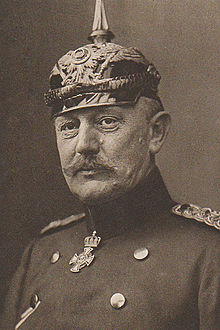
Von Molkte

I also thought it rather silly of Joffre not to press home his early advantage to save men so as to fight another day. The number of days the men had to fight, the number of men that were lost would have been significantly reduced if he had stood and fought with the massed army rather than the trench warfare that ensued. Perhaps this criticism is too harsh?

The naval blockade by the British was a natural response given their sea power and also the ease with which it could be applied against Germany with their very limited access to the sea. Of course this was going to affect trade between neutral nations and Germany but as a tactical device it was correct. The German response was to lay mines and develop submarine warfare both of which were effective but by going too far it brought the Americans into the war. The whole economical affect of the war at sea was dealt with very well.

I was interested to read about the loss of men on the Eastern front 430000 Austro-Hungarians casualties, 530000 Russians casualties  etc. The Balkan campaign cost the Austrians 15000 men and the Serbians 132000 men. The loss of life and injury at this early stage in the war is just staggering and when compared to the way the heavy losses the Somme are commemorated with reverence right up to today it is a shame that these men appear to be forgotten. 

What sort of contributions to science, engineering etc would some of these men or their descendants have made? 

Of course we will never know!!!!  

3 February 2015

Into Battle - Chapter 2!

The second chapter of this exceptionally readable book starts dramatically, with the French Army holding against the German Army onslaught! The costly lack of understanding of the developing industrial nature of warfare is best demonstrated in the early German advances at the Marne (1914) with French guns taking an awful toll – “mowing them down like a field of wheat”. The giving up of French territory in exchange for a higher German body-count is posed as a worthwhile tactic, with a Frenchman at the front line emphasising “We can rebuild a country; we cannot so easily rebuild a race”. It also posed a problem for the German Army, for whom a decisive victory on the Western Front was all-important & all-too impossible given their early losses.

Opening Moves; First Battle of the Marne

The stage was set. This war was to be a bloody one, with history at times relegating the staggering French & German losses early in the war to secondary importance. Not so in the opening of this chapter. The battle of the Marne is accurately portrayed as a significant halt of & drain on the German Army in the early goings, stopping them from reaching Paris.

The author gives a stellar introduction to the French Commander in Chief (CiC) General Joseph Joffre (as mentioned in the chapter, his contribution are often forgotten by history). In contrast to the German CiC General Von Moltke; who suffered a nervous breakdown trying to organise & rally the huge conscript army with archaic tactics, Joffre quickly noticed the onset of total or attritional warfare. Joffre cut many of the older French commanders loose, especially those who were unwilling or unaware of the dramatic changes.

French CiC General Joseph Joffre

I found fascinating the fact that military planning leading up to WWI focused on annihilation of the enemy in an open battlefield. Swift mobilisation, massing troops using trains as transports, finding the enemy, encircling the enemy & finally annihilating the enemy was taught all over Europe as the most potentially successful grand war strategy. This was to prove a flawed strategy, given the preparedness of the belligerents for total war. The chapter does make mention of the fact that the generals on all sides were aware of plan B, should the swift victory so hoped for not come to pass. And Plan B was exactly what happened.

Again plenty of references are made in this chapter to the advent of sophisticated weaponry the likes of which the world had not seen, leading to the demise of decisive tactical skill being the primary reason for victory. More powerful explosives, high-explosive shells, the breech-loaded rifle, the advent of the machine gun, rows upon rows of barbed wire, mines & the pervasive trenches, between which men were sent on suicidal attacks over open ground against all that sophisticated & deadly weaponry. It doesn’t even make mention of other weapons of mass destruction such as poison gas & underground high-explosives.

Vickers Machine Gun Manned by two men wearing Gas Masks

As alluded to in Chapter one, the lack of Russian military skill, especially when compared with that of exceptional German eastern front command (led by two future giants of Germany – Ludendorff & Paul Von Hindenburg – future chancellor), led to a halting of an initially dangerous attack through East Prussia. The lay of the land also helped to make Russian logistics (already a farce) even more difficult. This, given that most of the German Army was attempting to enact the already-dead-in-the-water Schlieffen plan in the west, & Austro-Hungarian (AH) soldiers were failing to achieve victories in Serbia or against the Russian Army’s perhaps softer southern underbelly, gave them a much needed respite.

The other interesting fact at this time was that opportunistic Italian neutrality (despite being a member of the Triple alliance) led AH to keep troops in reserve for the eventuality of a western (southern!) front of their own, which of course did eventually come to pass.

The second half of the chapter focuses more on the economic & social effect of the British blockade, which not only was huge advantageous for the armies of the Entente, but a massive strain on American-British relations, neutral country shipping & local business, many of which had a huge market in Germany & the rest of Europe which was now instantly restricted. Britain’s own maritime merchant fleet ended up bearing the brunt of the blockade, as it was the British Empire which still “ruled the waves”.

The financial effects of the blockade were widespread and were accompanied by immense diplomatic difficulties for the British, especially in convincing their neutral American cousins that it was a necessary measure.


The war at sea in the early goings shifted between classical British dominance above the waterline and innovative German dominance below it. The British had the most powerful navy in the world; the Germans had to adapt quickly to even the playing field. They employed two relatively new technologies, namely laying mines in British coastal waters & the introduction of a substantial fleet of deadly submarines. These proved to be a significant nuisance on sailing around the British Isles & the North Sea. However, the indiscriminate use of both techniques helped to lead America into the war on the side of Britain & France (especially following the sinking of the Cruise ship the Lusitania), and lacked the decisive firepower to open the commercial links to the Central Powers. The German navy, with 22 modern dreadnought-class warships, did not see extensive action in the war, and ended up just a very pretty chess piece left in the starting square. 

Sinking of the Lusitania