 |
| At the Marne |
Into Battle
The start of this chapter is super with the American expatriate in the garden of her cottage having a ringside view of the massed armies of France and German down in the Marne valley. The initial tactics, which would lead rapidly to a stalemate, were referenced to the only wars in living memory at that time i.e. the Franco-Prussian War, the American Civil War. Of course there had been colonial skirmishes in places such as India and South Africa (Boer War) but these were not suitable tactical references. Technology of warfare had improved so much that the cavalry charge so useful to gain advantage was now simply mown down by rapid firing weaponry that was available at that stage. Overwhelming force by sheer numbers of men was the order of the day. The conscript armies of France and Germany, the rapid mobilisation that was achievable due to the vast railway network, the availability of modern weaponry all helped to fool the Generals into thinking that a rapid and decisive victory was there for the taking. They were quickly disabused of this.
The short biography of Joffre was well put together. His engineering and logistical skills were highlighted as
giving his side a marked advantage. Note Lord Kitchener was also an engineer and logistican having built a railway to move his men and ensure supplies when avenging the death (beheaded by the Mahdi) of General Gordon at Khartoum some years before the beginning of the 20th century.
| Joffre |
 |
| Kitchener |
The contrast of these two men to the German commander Von Molkte who when it came to it did not have the psychological strength or at least sufficient confidence in his own ability. The only view I have on this is Von Molkte had a very eminent and successful military ancestor within his recent memory and he probably felt he would be compared to him. Of course he also has to contend with a very militaristic,l and demanding Emperor to contend with. In light of the outcome of the war he did well to get out of it as early as he did. As he wrote to his wife:
"Things have not gone well. The fighting east of Paris has not gone in our favour, and we shall have to pay for the damage we have done"
A very perceptive comment early on in the First World War!!!
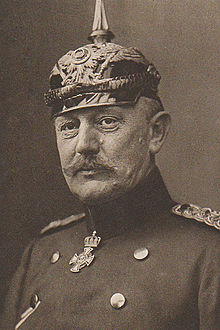 |
| Von Molkte |
I also thought it rather silly of Joffre not to press home his early advantage to save men so as to fight another day. The number of days the men had to fight, the number of men that were lost would have been significantly reduced if he had stood and fought with the massed army rather than the trench warfare that ensued. Perhaps this criticism is too harsh?
The naval blockade by the British was a natural response given their sea power and also the ease with which it could be applied against Germany with their very limited access to the sea. Of course this was going to affect trade between neutral nations and Germany but as a tactical device it was correct. The German response was to lay mines and develop submarine warfare both of which were effective but by going too far it brought the Americans into the war. The whole economical affect of the war at sea was dealt with very well.
I was interested to read about the loss of men on the Eastern front 430000 Austro-Hungarians casualties, 530000 Russians casualties etc. The Balkan campaign cost the Austrians 15000 men and the Serbians 132000 men. The loss of life and injury at this early stage in the war is just staggering and when compared to the way the heavy losses the Somme are commemorated with reverence right up to today it is a shame that these men appear to be forgotten.
What sort of contributions to science, engineering etc would some of these men or their descendants have made?
Of course we will never know!!!!

No comments:
Post a Comment